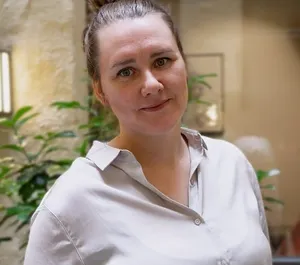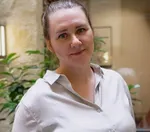
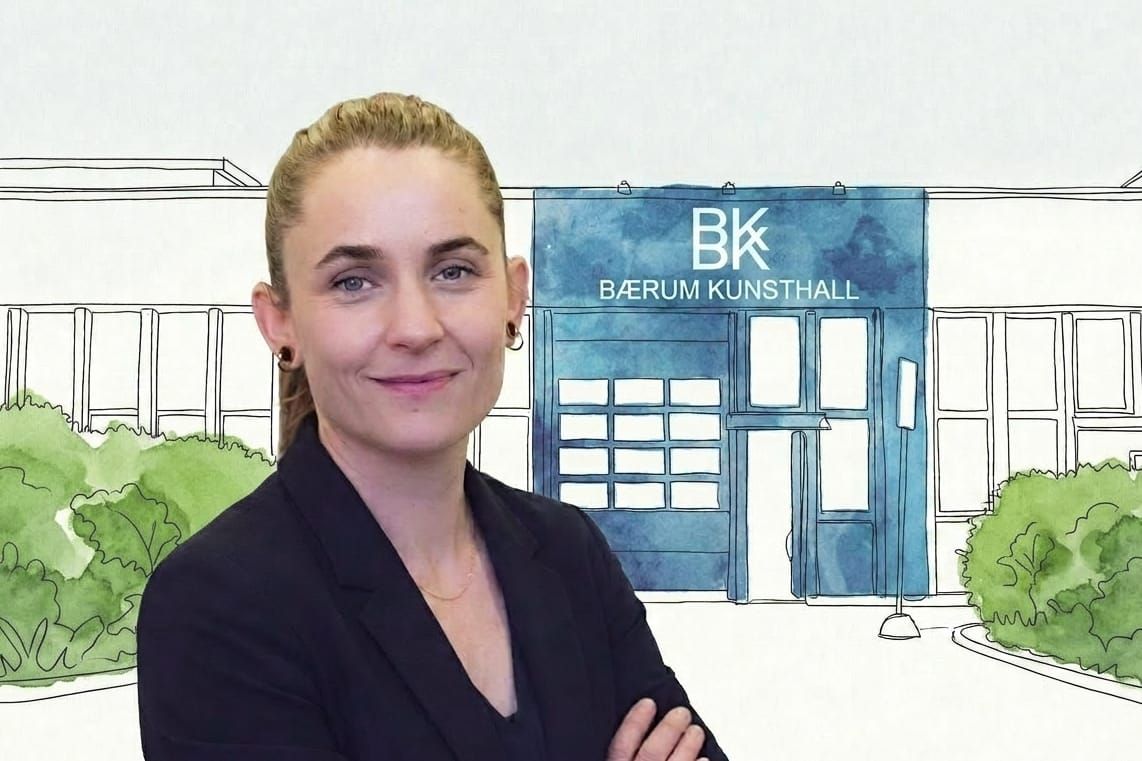
Pernille Gjærder Olsen has spent more than ten years working in Norwegian cultural institutions, mostly behind the scenes. She is the director (daglig leder) of Bærum Kunsthall, an artist-run art hall in an old fire station at Fornebu, in Bærum just west of Oslo. A kunsthall is a gallery with no permanent collection of its own, showing changing exhibitions of contemporary art. Before that, she was part of the leadership team at Wergelandshaugen, where she worked on programmes, with artists and on building the organisation.
Here she talks about growing up drawing on every surface, why she leads by listening, and what she hopes to achieve this year.
When did you realise that working with art and cultural institutions was more than a job for you?
From a very young age, art was already a natural part of how I related to the world. I was always drawing. I wanted to create my own fantasy worlds on the surfaces around me. Even though I wasn’t allowed to do that everywhere, my parents quickly understood that I had a strong need to express myself through something beyond words or written language.
Because of this, I attended a Steiner school, where creativity, materials, and artistic processes were given real space. From early on, I became deeply interested in materiality: how materials behave, how they relate to each other, and how working across techniques helps us understand the world more broadly.
Steiner schools, known in Norway as Steinerskolen and elsewhere as Waldorf schools, follow the educational ideas of Rudolf Steiner, with art, crafts and practical work at the heart of learning.
That curiosity has never left me. Perhaps we become less spontaneous as we grow older, but I believe we should never lose our ability to remain curious, loving, and creative. For me, working with art, and later with cultural institutions, felt like the most natural long-term direction.
What guides you when you choose a direction in your work?
What guides me most is listening: to people, to artists, and to the ideas that emerge in dialogue. When you work closely with artists, you encounter incredibly strong perspectives on society, on the world we live in, and on the challenges we face. Artists don’t always provide answers or solutions, but they offer different ways of seeing, and that is essential.
I am deeply interested in how people communicate and understand one another. I believe we have too much polarization and too many monologues today. Art has the potential to create dialogue instead: spaces where we listen rather than compete over who is right. If we are only interested in defending our own positions, we lose the opportunity to truly understand each other.
When you start a new project or work with a new space, what is the first thing you try to understand?
The first anchor is always the relationship between the artists, the space, and the people who will encounter the work.
At Bærum Kunsthall, for example, we work with three exhibition halls and alternate between curated exhibitions and open calls. Open calls make up about half of our yearly programme.
The institution itself grew out of an artist-driven initiative. It began in 2014 as a collaboration between artists, the municipality, and an art school, and in 2016 it developed into an art hall. We have our own board, with artists represented, and we curate independently. We are artist-driven, and that shapes every decision.
For me, understanding the identity of the place and respecting the artistic vision is essential. Only then can meaningful dialogue with the surrounding community emerge.
Women hold more visible roles in culture today, but their paths are rarely straightforward. What matters most in female leadership, and what challenges have you faced?
I don’t think women have to work more or produce more than men in order to succeed in art. The bigger challenge is social: claiming your space and your right to be there, being taken seriously, and being visible. Art is not a place where you “work harder” in a traditional sense to achieve a clear reward, because it’s art. It’s about how you express yourself and how you communicate something, and you can’t compare that to, for example, finance.
At the same time, I do agree that men are often more successful and more famous. If you count the numbers, we clearly don’t have a 50–50 balance.
Personally, I think it’s important to talk openly about what it takes to combine leadership and life, especially today, when many women are career-driven and also mothers. It can be hard to combine everything and still feel whole. Many women carry what we call the “third shift”: the mental load, always holding everything in their head, always focused. It drains you. That’s why support matters. Having someone who says, “You’re on the right path. I’m here. I support you,” is essential. And we also need celebration, because we’ve worked hard to get where we are today.
Your work combines budgets and planning with creativity and unpredictability. How do you balance the two?
I often ask myself this question. I work with budgets, Excel files, applications, reports, and politicians. At first glance, it may seem far from art. But I still feel that I am creating something.
Mediating between artists, students, and audiences gives me many of the same emotions as creating art myself. It is not the same, of course (I don't take artistic credit), but the connection and understanding feel deeply meaningful. I would call it love. And I also like breaking the idea that visitors must “perform” or understand everything. Many people come into the gallery with expectations, feeling they have to do something. I try to break that completely. I want people to feel free to ask questions, laugh, communicate, and have a real conversation.
The arts are under pressure from new technology, economics and social change. Why does supporting art matter now, and what would you say to those shaping the cultural sector?
I believe art is slowly losing some of its freedom to speak, partly because it is increasingly viewed through an economic lens. We talk about value, funding, and capital, but we forget love.
Art is not always profitable, but it is deeply valuable. It creates spaces for dialogue, disagreement, and understanding. We can hold different opinions and still remain human and connected. That is why I believe in supporting art not only at the institutional level, but as something that should be part of society more broadly.
My message would be: follow the art. Give more money to small and medium-sized venues, because that’s where art is actually created, and that’s where the most exciting dialogue happens. Invite art to be part of life, not necessarily every day, but more often.
Invite art into kindergartens and schools, but let art have its own projects and its own artistic integrity. Trust the art. Invite artists to work with you. Invite artists to leadership seminars. If you have the right artist in the right place, you get encounters that give you perspectives and ways of thinking you never had before, perspectives that can change how you work.
What do we need when we no longer have hope? We need different perspectives. We need to find hope. We need to find joy. We need inspiration. We live in a society that can feel quite dark, and art can give us hope and an idea of freedom.
There is no clear career ladder in the arts. Is building a career there realistic, and how will new technologies and AI change the field?
Building a career in the arts requires dedication and a willingness to live with uncertainty, including financial insecurity, especially in the beginning. It may take 10–15 years before you can fully support yourself through art as an artist if you ever get there.
At the same time, education and institutional structures matter. Art education can be a shortcut, not because autodidacts lack quality, but because the system often supports formally educated artists more easily. Whichever path you choose, you must be prepared to dedicate your life to it.
I also think it is important to remember that creativity is not optional; it is necessary in all professions. Children today are surrounded by screens, often without learning about materials, craftsmanship, or critical thinking. Art, and exposure to art, helps people think independently, reflect, and make thoughtful decisions. In that sense, regardless of new technologies, the human need for creativity, meaning, and perspective is not going away.
What are your ambitions as a leader this year?
Professionally, I want to do more networking with small and medium-sized institutions, for example Bergen Kunsthall, to collaborate and form a stronger voice towards politicians. I also want to expand mediation programmes for different age groups and social contexts.
I want people to take a five-minute break, experience art, maybe have lunch in the gallery, and then go back to work. Even 15–30 minutes can add something valuable to a workday.
This year we have eight exhibition periods and around twenty exhibitions in total. We’ve invited artists through open calls: artists from Turkey, Iran, Serbia, Finland, Russia, Sweden, and Norway. I find it very interesting to bring them together and create dialogue across borders.
What advice would you give women who want a meaningful career in contemporary art, without necessarily becoming well known?
What women need is support, someone who says: “You’re on the right path. I’m here. I support you.” We need more openness, more kindness, and more support between women. Traditional roles are changing, and every family must find what works best for them, including for those who are single parents.
And more broadly, I would say: be genuinely interested in what you believe in. Learn both material skills and critical thinking. Art needs people who care deeply, not only about success, but about meaning, responsibility, and humanity.
Find out more about Bærum Kunsthall at baerumkunsthall.no.